Laser tattoo removal
A safe, gradual solution for clear skin
What is laser tattoo removal?
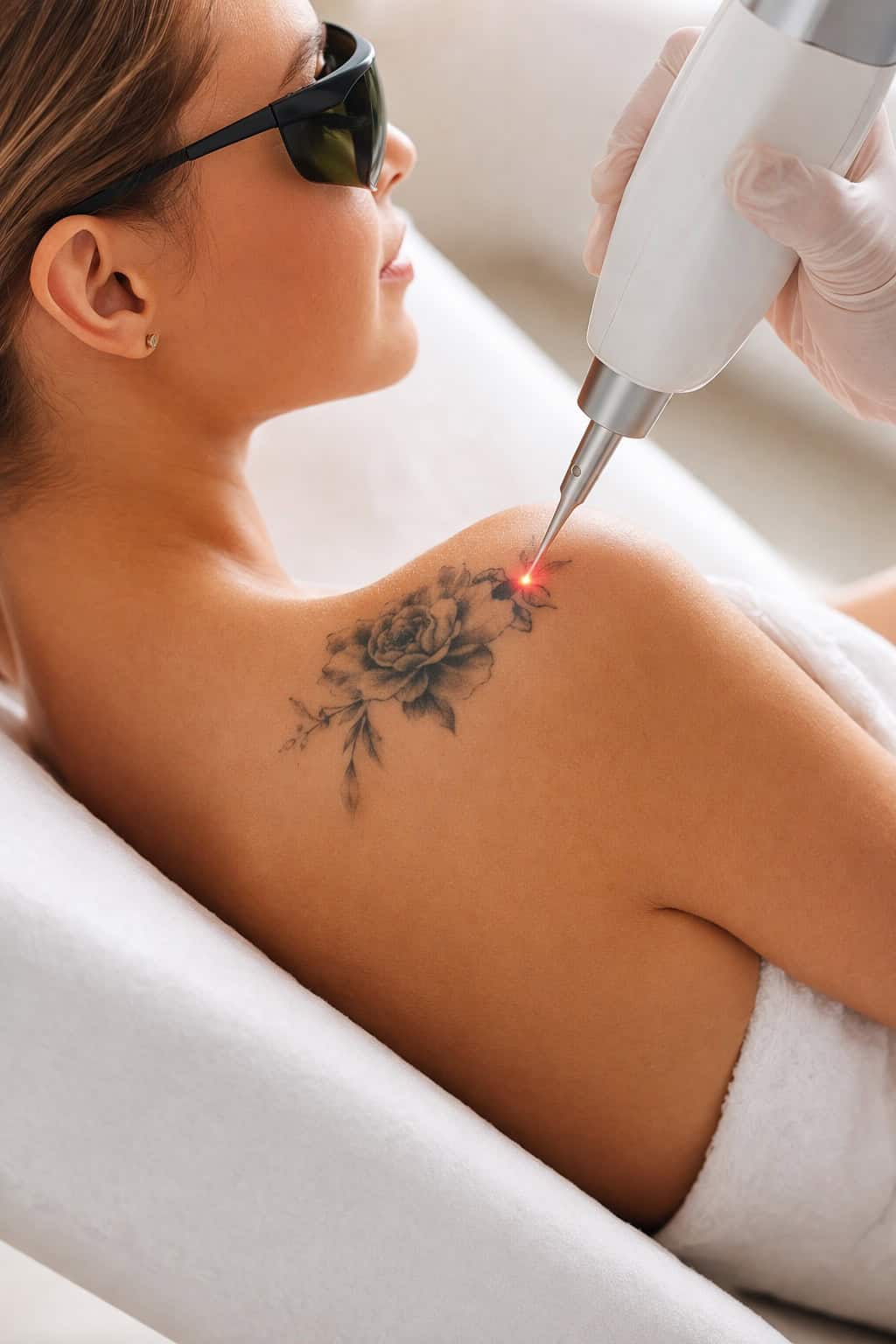
Laser tattoo removal is the reference method offered at the Clinique Esthétique des Musiciens in Nice to remove a tattoo safely. It uses a specific laser that targets the tattoo pigments without damaging the surrounding skin.
The laser emits a very high-speed shock wave that breaks the tattoo pigments into microparticles. These fragments are then gradually eliminated by the immune system.
What are the benefits of laser tattoo removal?
Laser tattoo removal can:
- Fully or partially remove a tattoo gradually and in a controlled way
- Precisely target the pigments without damaging the surrounding tissue
- Treat tattoos of different sizes and locations
- Offer a treatment performed under strict medical supervision, with an approved medical laser device
- Gradually achieve even, clear skin
Results are visible from the first sessions and improve over the course of the protocol.
Who is laser tattoo removal for?
This treatment suits anyone who wants to:
- completely remove an unwanted tattoo,
- partially lighten a tattoo before covering it with a new one,
- correct a tattoo that was poorly done or has aged badly,
- or remove a tattoo on a visible area (hands, neck, face…).
Black, blue and red inks respond particularly well to laser treatment. However, some colours such as yellow or white do not respond in the same way. The doctor assesses the expected response case by case, according to the pigments used.
Our medical team in Nice assesses the feasibility of treatment during the consultation, based on your tattoo’s characteristics, and defines a personalised protocol with you.
What happens during a laser tattoo removal session?
1Initial consultation
The doctor assesses whether full or partial removal is feasible and may offer a test session. He analyses the tattoo’s characteristics: type of ink, pigments, density and depth, to define the right protocol.
2The treatment
The laser breaks the pigments into microparticles, which are then naturally eliminated by the body. The session is targeted and precise, with no damage to the surrounding tissue.
3After the session
- Slight redness or sensitivity may appear temporarily.
- Good healing and sun protection are essential to optimise the result.
- An interval of two months between sessions is observed to give the immune system time to work.
📅 The number of sessions is generally between 4 and 10, depending on the tattoo’s characteristics.
Results and maintenance
The first changes are visible from the first sessions, with the tattoo gradually lightening. Black and dark inks fade more easily than light colours. After several sessions, the tattoo gradually disappears, leaving even skin.
The final result depends on the tattoo’s specific features: colour, depth and density of the pigments.
Contraindications
- Pregnancy and breastfeeding
- Tanned skin or recent sun exposure on the area
- Certain active skin diseases in the area to be treated
- Photosensitising medication (to be assessed during the consultation)
Prices
| Treated area | Price |
|---|---|
|
Eyebrows |
€100 |
|
< 5 cm2 |
100 € |
|
5-15 cm2 |
150 € |
|
16-50 cm2 |
200 € |
⏐ A personalised quote is provided after the first consultation.
Why choose our centre in Nice
✅ Technique performed only by a trained doctor, in a safe medical setting
✅ Latest-generation medical laser for precise, effective treatment
✅ A personalised protocol based on your tattoo’s characteristics ✅ Medical follow-up at every session to optimise results